Monday, 23 September 2013

Guildhall Art Gallery

Guildhall Art Gallery Definition

Source link (google.com)


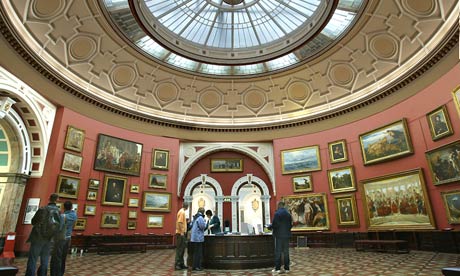
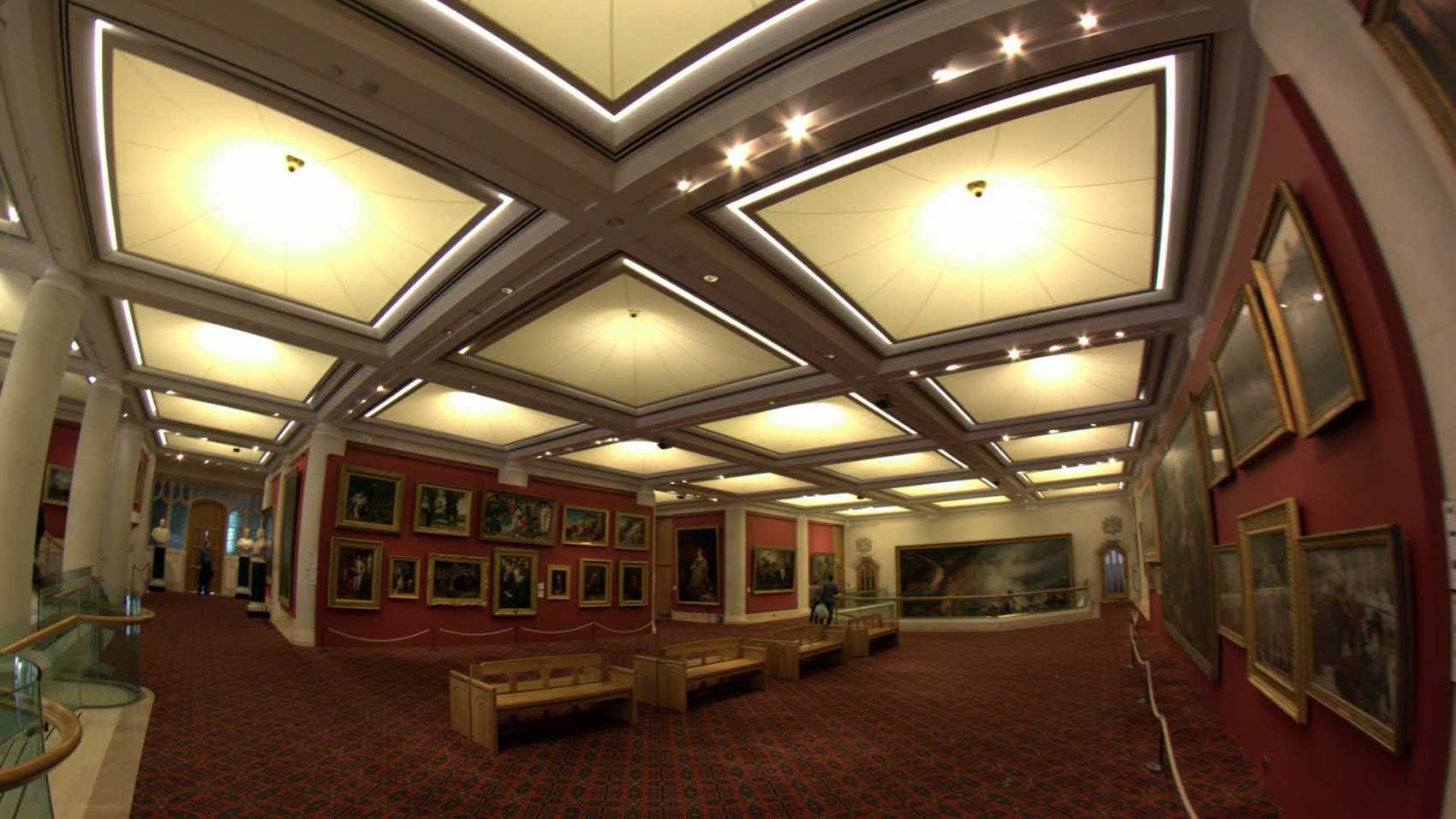
Guildhall is a building in the City of London, off Gresham and Basinghall streets, in the wards of Bassishaw and Cheap. It has been used as a town hall for several hundred years, and is still the ceremonial and administrative centre of the City of London and its Corporation. The term Guildhall refers both to the whole building and to its main room, which is a medieval-style great hall. Guildhall complex houses the offices of the City of London Corporation and various public facilities. The building is traditionally referred to as Guildhall never "the" Guildhall.Guildhall should not be confused with London City Hall, which is the administrative centre for Greater London, of which the City of London is only a geographically small part.The Guildhall Art Gallery houses the art collection of the City of London, England. It occupies a building that was completed in 1999 to replace an earlier building destroyed in The Blitz in 1941. It is a stone building in a semi-gothic style intended to be sympathetic to the historic Guildhall, which is adjacent and to which it is connected internally.The gallery was originally built in 1885 to house art collections from the City of London Corporation and the present collection consists of about 4,000 works, of which around 250 are on display at any one time. Many of the paintings are of London themes. There is also a significant collection of Victorian era art, including Pre-Raphaelites, which features paintings by artists such as John Everett Millais, Dante Gabriel Rossetti, Abraham Solomon, Edward John Poynter and Edwin Landseer, and a view of Salisbury Cathedral by John Constable. The centrepiece of the largest gallery is John Singleton Copley's huge painting The Defeat of the Floating Batteries at Gibraltar.
The Guildhall complex was built on the site of London's Roman amphitheatre, and some of the remains of this are displayed in situ in a room in the basement of the art gallery. Discovered in 1998, the site is now a protected monument. It is under the Guildhall Art Gallery. London's first Roman amphitheatre was built in AD70 from wood but was renovated in the early 2nd century with tiled entrances and rag-stone walls. The amphitheatre was used for various public events such as gladiator games, entertaining soldiers and the public with animal fighting and public execution of criminals, as well as religious activities. When the ancient Romans left in the 4th century the amphitheatre lay derelict for hundreds of years. In the 11th century the area was reoccupied and by the 12th century the first Guildhall was built next to it.The great hall is believed to be on a site of an earlier Guildhall (one possible derivation for the word 'guildhall' is the Anglo-Saxon 'gild', meaning payment, with a "gild-hall" being where citizens would pay their taxes). During the Roman period, it was the site of an amphitheatre, the largest in Britannia, partial remains of which are on public display in the basement of Guildhall Art Gallery and the outline of whose arena is marked with a black circle on the paving of the courtyard in front of the hall. Indeed, the siting of the Saxon Guildhall here was probably due to the amphitheatre's remains[1] Excavations by MOLAS in 2000 at the entrance to Guildhall Yard exposed remains of the great 13th-century gatehouse built directly over the southern entrance to the Roman amphitheatre, which raises the possibility that enough of the Roman structure survived to influence the siting not only of the gatehouse and Guildhall itself but also of the church of St Lawrence Jewry whose strange alignment may shadow the elliptical form of the amphitheatre beneath.[2] The first documentary reference to a London Guildhall is dated 1128 and the current hall's west crypt may be part of a late-13th century building. Legendary British history made Guildhall's site the site of the palace of Brutus of Troy.

Guildhall Art Gallery

Guildhall Art Gallery

Guildhall Art Gallery

Guildhall Art Gallery
Guildhall Art Gallery

Guildhall Art Gallery

Guildhall Art Gallery

Guildhall Art Gallery

Guildhall Art Gallery

Guildhall Art Gallery

Guildhall Art Gallery

Hamilton Art Gallery

Hamilton Art Gallery Definition

Source link (google.com)

Hamilton artIn pre-colonial times, the Neutral Indians used much of the land but were gradually driven out by the Five (later Six) Nations (Iroquois) who were allied with the British against the Huron and their French allies. A member of the Iroquois Confederacy provided the route and name for Mohawk Road, which originally included King Street in the lower city. In 1784, about 10,000 United Empire Loyalists settled in Upper Canada (what is now southern Ontario), chiefly in Niagara, around the Bay of Quinte, and along the St. Lawrence River between Lake Ontario and Montreal. They were soon followed by many more Americans, some of them not so much ardent loyalists but attracted nonetheless by the availability of inexpensive, arable land. At the same time, large numbers of Iroquois loyal to Britain arrived from the United States and were settled on reserves west of Lake Ontario.
The town of Hamilton was conceived by George Hamilton (a son of a Queenston entrepreneur and founder, Robert Hamilton), when he purchased farm holdings of James Durand, the local Member of the British Legislative Assembly, shortly after the War of 1812. Nathaniel Hughson, a property owner to the north, cooperated with George Hamilton to prepare a proposal for a courthouse and jail on Hamilton's property. Hamilton offered the land to the crown for the future site. Durand was empowered by Hughson and Hamilton to sell property holdings which later became the site of the town. As he had been instructed, Durand circulated the offers at York during a session of the Legislative Assembly and a new Gore District was established of which the Hamilton townsite was a member.
Initially, this town was not the most important centre of the Gore District. A permanent jail was not constructed until 1832 when a cut-stone design was completed on one of the two squares created in 1816, Prince's Square.Subsequently, the first police board and the town limits were defined by statute on February 13, 1833. Official City status was achieved on June 9, 1846, by an act of Parliament, 9 Victoria Chapter 73.
As the city grew, several prominent buildings were constructed in the late 19th century, including the Grand Lodge of Canada in 1855,West Flamboro Methodist Church in 1879 (later purchased by Dufferin Masonic Lodge in 1893), a public library in 1890, and the Right House department store in 1893. The first commercial telephone service in Canada, the first telephone exchange in the British Empire, and the second telephone exchange in all of North America all were established in the city between 1877–78.[17] The city had several interurban electric street railways and two inclines, all powered by the Cataract Power Co is a port city in the Canadian province of Ontario. Conceived by George Hamilton when he purchased the Durand farm shortly after the War of 1812, Hamilton has become the centre of a densely populated and industrialized region at the west end of Lake Ontario known as the Golden Horseshoe. On January 1, 2001, the new City of Hamilton was formed through the amalgamation of the former city and the other constituent lower-tier municipalities of the Regional Municipality of Hamilton-Wentworth with the upper-tier regional government. Residents of the old city are known as Hamiltonians. Since 1981, the metropolitan area has been listed as the ninth largest in Canada and the third largest in Ontario.
Hamilton is home to the shared Royal Botanical Gardens, the Canadian Warplane Heritage Museum, the Bruce Trail, McMaster University and Mohawk College. The Canadian Football Hall of Fame can be found downtown right beside Hamilton City Hall and across town to the east, the Canadian Football League's Hamilton Tiger-Cats will begin playing at the new Tim Hortons Field in 2014, which is being built as part of the 2015 Pan American Games.
Partly because of its diverse environment, numerous TV and film productions have been filmed in Hamilton, regulated by the Hamilton Film and Television Office.A growing arts and culture sector garnered media attention in a 2006 Globe and Mail news article, entitled "Go West, Young Artist," which focused on the growing art scene in Hamilton. The article highlighted local art galleries, recording studios and independent film production.

Hamilton Art Gallery

Hamilton Art Gallery

Hamilton Art Gallery

Hamilton Art Gallery

Hamilton Art Gallery

Hamilton Art Gallery

Hamilton Art Gallery

Hamilton Art Gallery

Hamilton Art Gallery

Hamilton Art Gallery

Hamilton Art Gallery

Digital Art Galleries

Digital Art Galleries Definition

Source link (google.com)

Digital art galleries is a type of art which relies on moving pictures and comprises video and/or audio data. (It should not however be confused with television production or experimental film.) Video art came into existence during the late 1960s and early 1970s as the new technology became available outside corporate broadcasting and is still widely practiced and has given rise to the widespread use of video installations. Video art can take many forms: recordings that are broadcast, viewed in galleries or other venues, or distributed as video tapes or DVD discs; sculptural installations, which may incorporate one or more television sets or video monitors, displaying ‘live’ or recorded images and sound; and performances in which video representations are included.
This article needs additional citations for verification. Please help improve this article by adding citations to reliable sources. Unsourced material may be challenged and removed. (November 2007)
Digital art galleries is named after the original analog video tape, which was most commonly used in the form's early years, but before that artists had already been working in film. With the advent of digital technology (Hard Disk, CD-ROM, DVD, and solid state) this superseded tape but the electronic video signal remains the carrier of moving image work. Despite obvious parallels and relationships, video art is not experimental film.
One of the key differences between video art and theatrical cinema is that video art does not necessarily rely on many of the conventions that define theatrical cinema. Video art may not employ the use of actors, may contain no dialogue, may have no discernible narrative or plot, or adhere to any of the other conventions that generally define motion pictures as entertainment. This distinction is important, because it delineates video art not only from cinema but also from the subcategories where those definitions may become muddy (as in the case of avant garde cinema or short films). Video art's intentions are varied, from exploring the boundaries of the medium itself (e.g., Peter Campus, Double Vision) to rigorously attacking the viewer's expectations of video as shaped by conventional cinema (e.g., Joan Jonas, Organic Honey's Vertical Roll).In 1958 Wolf Vostell becomes the first artist who incorporates a television set into one of his works. The installation Black Room Cycle.Transmigracion 1-3, 1958, are also early works with incorpareted television. In 1963 Wolf Vostell exhibited the installation 6 TV Dé-coll/age at the Smolin Gallery in New York. Also in 1963 Wolf Vostell made the video Sun in your head.
Nam June Paik had his first exhibition with manipulated TV in 1963 at the Gallery Parnass in Wuppertal. Video art is often said to have begun when Nam June Paik used his new Sony Portapak to shoot footage of Pope Paul VI's procession through New York City in the autumn of 1965. That same day, across town in a Greenwich Village cafe, Paik played the tapes and digital art galleries was born. The French artist Fred Forest has also used a Sony Portapak since 1967. Both these claims are however often rigorously disputed because the first Sony Portapak, the Videorover did not become commercially available until 1967, first in the US and that Andy Warhol is credited with showing underground video art mere weeks before Paik's papal procession screening, but here probably made on a pre-portable mains deck.
Prior to the introduction of this new technology, moving image production was only available to the consumer (or the artist for that matter) by way of eight or sixteen millimeter film, but did not provide the instant playback that video tape technologies offered. Consequently, many artists found video more appealing than film, even more so when the greater accessibility was coupled with technologies which could edit or modify the video image.
The two examples mentioned above both made use of "low tech tricks" to produce early video art works. American artist Peter Campus' Double Vision combined the video signals from two Sony Portapaks through an electronic mixer, resulting in a distorted and radically dissonant image and Jonas' Organic Honey's Vertical Roll involved recording previously recorded material as it was played back on a television — with the vertical hold setting intentionally in error.
The first multi-channel video art (using several monitors or screens) was Wipe Cycle by Ira Schneider and Frank Gillette. An installation of nine television screens, Wipe Cycle for the first time combined live images of gallery visitors, found footage from commercial television, and shots from pre-recorded tapes. The material was alternated from one monitor to the next in an elaborate choreography.
At the USA's San Jose State TV studios in 1970, Willoughby Sharp began the “Videoviews” series of videotaped dialogues with artists. The “Videoviews” series consists of Sharps’ dialogues with Bruce Nauman (1970), Joseph Beuys (1972), Vito Acconci (1973), Chris Burden (1973), Lowell Darling (1974), and Dennis Oppenheim (1974). Also in 1970, Sharp curated “Body Works,” an exhibition of video works by Vito Acconci, Terry Fox, Richard Serra, Keith Sonnier, Dennis Oppenheim and William Wegman which was presented at Tom Marioni's Museum of Conceptual Art, San Francisco, California.
Meanwhile in the UK David Hall's "TV Interruptions" (1971) were transmitted intentionally unannounced and uncredited on Scottish TV, the first artist interventions on British television.

Digital Art Galleries 

Digital Art Galleries 

Digital Art Galleries 

Digital Art Galleries 

Digital Art Galleries 


Digital Art Galleries 

Digital Art Galleries 

Digital Art Galleries 

Digital Art Galleries 

Digital Art Galleries 

Digital Art Galleries 

Modern Art Gallery Online

Modern Art Gallery Online Definition

Source link (google.com)

Defining modern art gallery online can be difficult. Aestheticians and art philosophers often engage in disputes about how to define art. By its original and broadest definition, art (from the Latin ars, meaning "skill" or "craft") is the product or process of the effective application of a body of knowledge, most often using a set of skills; this meaning is preserved in such phrases as "liberal arts" and "martial arts". However, in the modern use of the word, which rose to prominence after 1750, “art” is commonly understood to be skill used to produce an aesthetic result (Hatcher, 1999).
Britannica Online defines it as "the use of skill and imagination in the creation of aesthetic objects, environments, or experiences that can be shared with others".[2] But how best to define the term “art” today is a subject of much contention; many books and journal articles have been published arguing over even the basics of what we mean by the term “art” (Davies, 1991 and Carroll, 2000). Theodor Adorno claimed in 1969 “It is self-evident that nothing concerning art is self-evident any more.” It is not clear who has the right to define art. Artists, philosophers, anthropologists, and psychologists all use the notion of art in their respective fields, and give it operational definitions that are not very similar to each other's.
The second, more narrow, more recent sense of the word “art” is roughly as an abbreviation for creative art or “fine art.” Here we mean that skill is being used to express the artist’s creativity, or to engage the audience’s aesthetic sensibilities. Often, if the skill is being used to create objects with a practical use, rather than paintings or sculpture with no practical function other than as an artwork, it will be considered it as falling under classifications such as the decorative arts, applied art and craft rather than fine art. Likewise, if the skill is being used in a commercial or industrial way, it will be considered design instead of art. Some thinkers have argued that the difference between fine art and applied art has more to do with value judgments made about the art than any clear definitional difference (Novitz, 1992). The modern distinction does not work well for older periods, such as medieval art, where the most highly regarded art media at the time were often metalwork, engraved gems, textiles and other "applied arts", and the perceived value of artworks often reflected the cost of the materials and sheer amount of time spent creating the work at least as much as the creative input of the artist.The traditional Western classifications since the Renaissance have been variants of the hierarchy of genres based on the degree to which the work displays the imaginative input of the artist, using artistic theory that goes back to the ancient world. Such thinking received something of a boost with the aesthetics of Romanticism. A similar theoretical framework applied in traditional Chinese art; for example in both the Western and Far Eastern traditions of landscape painting (see literati painting), imaginary landscapes were accorded a higher status than realistic depictions of an actual landscape view - in the West relegated to "topographical views".
Many have argued that it is a mistake to even try to define art or beauty, that they have no essence, and so can have no definition. Often, it is said that art is a cluster of related concepts rather than a single concept. Examples of this approach include Morris Weitz and Berys Gaut.
Andy Warhol exhibited wooden sculptures of Brillo Boxes as art.
Another approach is to say that “art” is basically a sociological category, that whatever art schools and museums, and artists get away with is considered art regardless of formal definitions. This institutional theory of art has been championed by George Dickie. Most people did not consider a store-bought urinal or a sculptural depiction of a Brillo Box to be art until Marcel Duchamp and Andy Warhol (respectively) placed them in the context of art (i.e., the art gallery), which then provided the association of these objects with the values that define art.
Proceduralists often suggest that it is the process by which a work of art is created or viewed that makes it, art, not any inherent feature of an object, or how well received it is by the institutions of the art world after its introduction to society at large. For John Dewey, for instance, if the writer intended a piece to be a poem, it is one whether other poets acknowledge it or not. Whereas if exactly the same set of words was written by a journalist, intending them as shorthand notes to help him write a longer article later, these would not be a poem.
Leo Tolstoy, on the other hand, claims that what makes something art or not is how it is experienced by its audience, not by the intention of its creator.[citation needed] Functionalists, like Monroe Beardsley argue that whether a piece counts as art depends on what function it plays in a particular context. For instance, the same Greek vase may play a non-artistic function in one context (carrying wine), and an artistic function in another context (helping us to appreciate the beauty of the human figure).

Modern Art Gallery Online

Modern Art Gallery Online

Modern Art Gallery Online

Modern Art Gallery Online

Modern Art Gallery Online

Modern Art Gallery Online

Modern Art Gallery Online

Modern Art Gallery Online

Modern Art Gallery Online

Modern Art Gallery Online

Modern Art Gallery Online

Jobs In Art Galleries

Jobs In Art Galleries Definition

Source Link (google)

Job In Art Galleries is a manager or overseer. Traditionally, a curator or keeper of a cultural heritage institution (e.g., gallery, museum, library or archive) is a content specialist responsible for an institution's collections and involved with the interpretation of heritage material. The object of a traditional curator's concern necessarily involves tangible objects of some sort, whether it be artwork, collectibles, historic items or scientific collections. More recently, new kinds of curators are emerging: curators of digital data objects and biocurators.In smaller organizations, a curator may have sole responsibility for the acquisition and care of objects. The curator will make decisions regarding what objects to take, oversee their potential and documentations, conduct research based on the collection and history that provides propered packaging of art for transportation, and share that research with the public and community through exhibitions and publications. In very small volunteer-based museums, such as local historical societies, a curator may be the only paid staff member.In larger institutions, job in art galleries primary function is as a subject specialist, with the expectation that he or she will conduct original research on objects and guide the organization in its collecting. Such institutions can have multiple curators, each assigned to a specific collecting area (e.g. Curator of Ancient Art, Curator of Prints and Drawings, etc.) and often operating under the direction of a head curator. In such organizations, the physical care of the collection may be overseen by museum collections managers or museum conservators, and documentation and administrative matters (such as insurance and loans) are handled by a museum registrar.In the United Kingdom, the term curator is also applied to government employees who monitor the quality of contract archaeological work under Planning Policy Guidance 16: Archaeology and Planning (PPG 16) and are considered to manage the cultural resource of a region. In the museum setting, a curator in the United Kingdom may also be called a "keeper".In Scotland, the term "curator" is used to mean the guardian of a child.In the United States, the term can also be used to refer to a member of the University of Missouri Board of Curators, the governing body of the University of Missouri System. The Board consists of nine members appointed by the state governor.More recently, advances in new technologies have led to a further widening of the role of curator. This has been focused in major art institutions internationally and has become an object of academic study and research.In contemporary art, the title curator is given to a person who selects and often interprets works of art. In addition to selecting works, the curator often is responsible for writing labels, catalog essays, and other supporting content for the exhibition. Such curators may be permanent staff members, be "guest curators" from an affiliated organization or university, or be "freelance curators" working on a consultant basis. The late twentieth century saw an explosion of artists organizing exhibitions. The artist-curator has a long tradition of influence. Notable among these was Sir Joshua Reynolds, founder of the Royal Academy, London.In some American organizations, the term curator is also used to designate the head of any given division of a cultural organization. This has led to the proliferation of titles such as "Curator of Education" and "Curator of Exhibitions". The term "literary curator" has been used to describe persons who work in the field of poetry, such as former 92nd Street Y poetry director Karl Kirchwey.[1] This trend has increasingly been mirrored in the United Kingdom in such institutions as Ikon, Birmingham, UK and Baltic, Gateshead, UK.In Australia and New Zealand, the term is also applied to a person who prepares a sports ground for use (especially a cricket ground)[2] This job is equivalent to that of groundsman in some other cricketing nations.In France, the term curator is translated as conservateur. There are two kind of curators, Heritage curators (conservateurs du patrimoine) with five specialities (archeology, archives, museums, historical monuments, natural science museums), and Librarian curators (conservateurs des bibliothèques). These curators are in public service, selected by competitive exam, the use of the title curator by private workers remains unofficial.

Jobs In Art Galleries

 Jobs In Art Galleries

 Jobs In Art Galleries


Jobs In Art Galleries

Jobs In Art Galleries

Jobs In Art Galleries

Jobs In Art Galleries

Jobs In Art Galleries

Jobs In Art Galleries

Jobs In Art Galleries

Jobs In Art Galleries